I've recently ventured into the podcast world. I've been wanting to do one for a long time, and I'm thankful that I'm finally able to do that with my friend Seth. Now that it's been out for a bit, I thought I'd share a bit about my setup. I'm starting out in this space; I went with some equipment that, while not the top end, is widely recommended for a beginner: the Blue Yeti microphone. I ended up getting one on Amazon Prime Day, as well as a DragonPad pop filter. My initial plan was to use 2 iOS devices: an iPhone 5c for the FaceTime call and my iPhone Plus for recording, utilizing the Lightning to USB3 adapter to record my end using Ferrite.1 However, I was gifted a 2009 Mac mini, which surprisingly still works well for recording. We use FaceTime Audio to make the call and Audio Hijack to record. So while I use iOS for everything in my personal life, this is the only thing for which I use a Mac.2
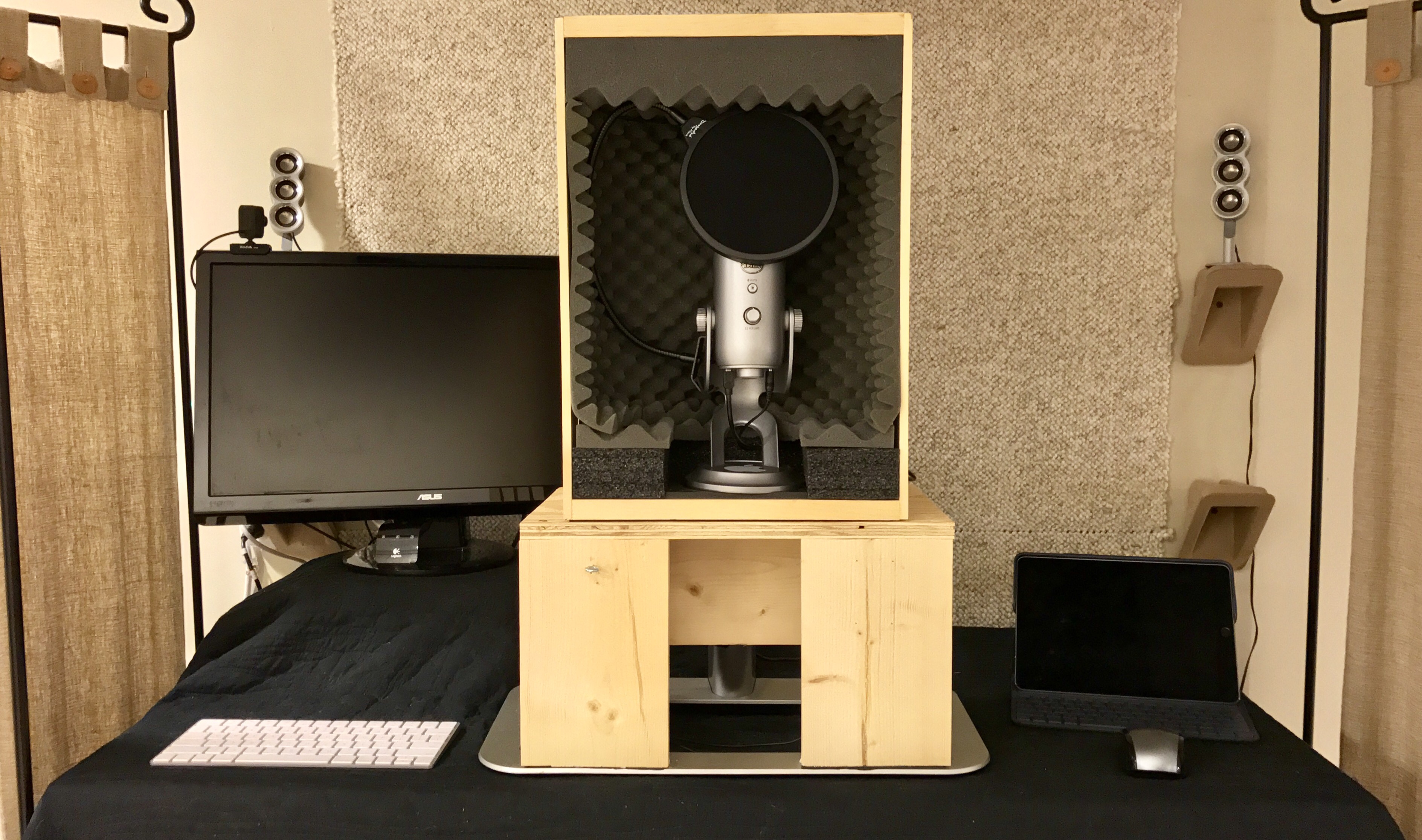
With my recording hardware set, I needed a good space to record. One particular area in our basement was pretty well isolated from the house, and would be a good place to start. First, I needed a decent desk. My parents brought me the unused drafting table from their house, and I was able to set it up at a good height for standing. I added some 2" scrap foam blocks and an unused piece of 3/4" plywood to elevate the desktop to a comfortable height for me; I also added some other spare wood that I cut to length so that I could elevate the monitor a bit. I covered it with a blanket I wasn't using to help attenuate the metallic noise from the desk itself. Though that portion of the basement is carpeted, I also bought an anti-fatigue mat that helped with standing while recording.
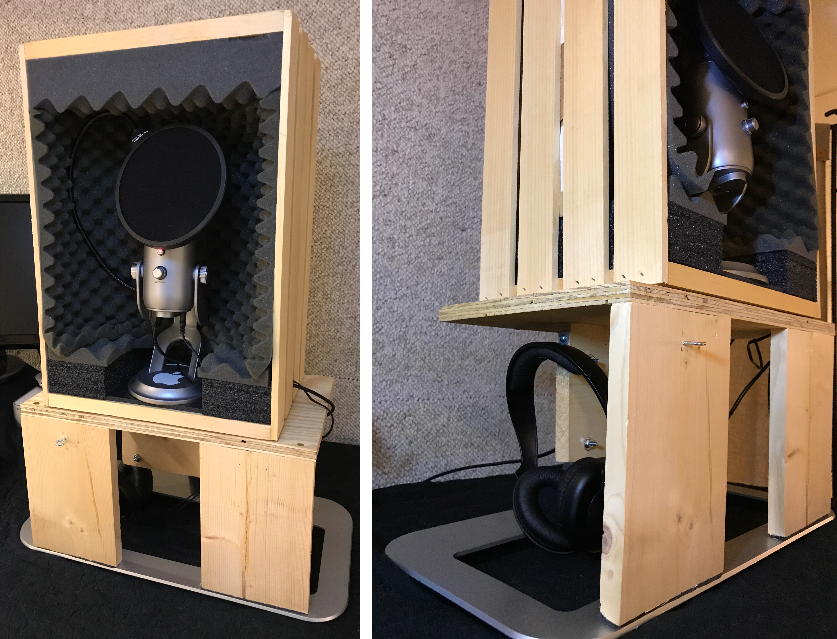
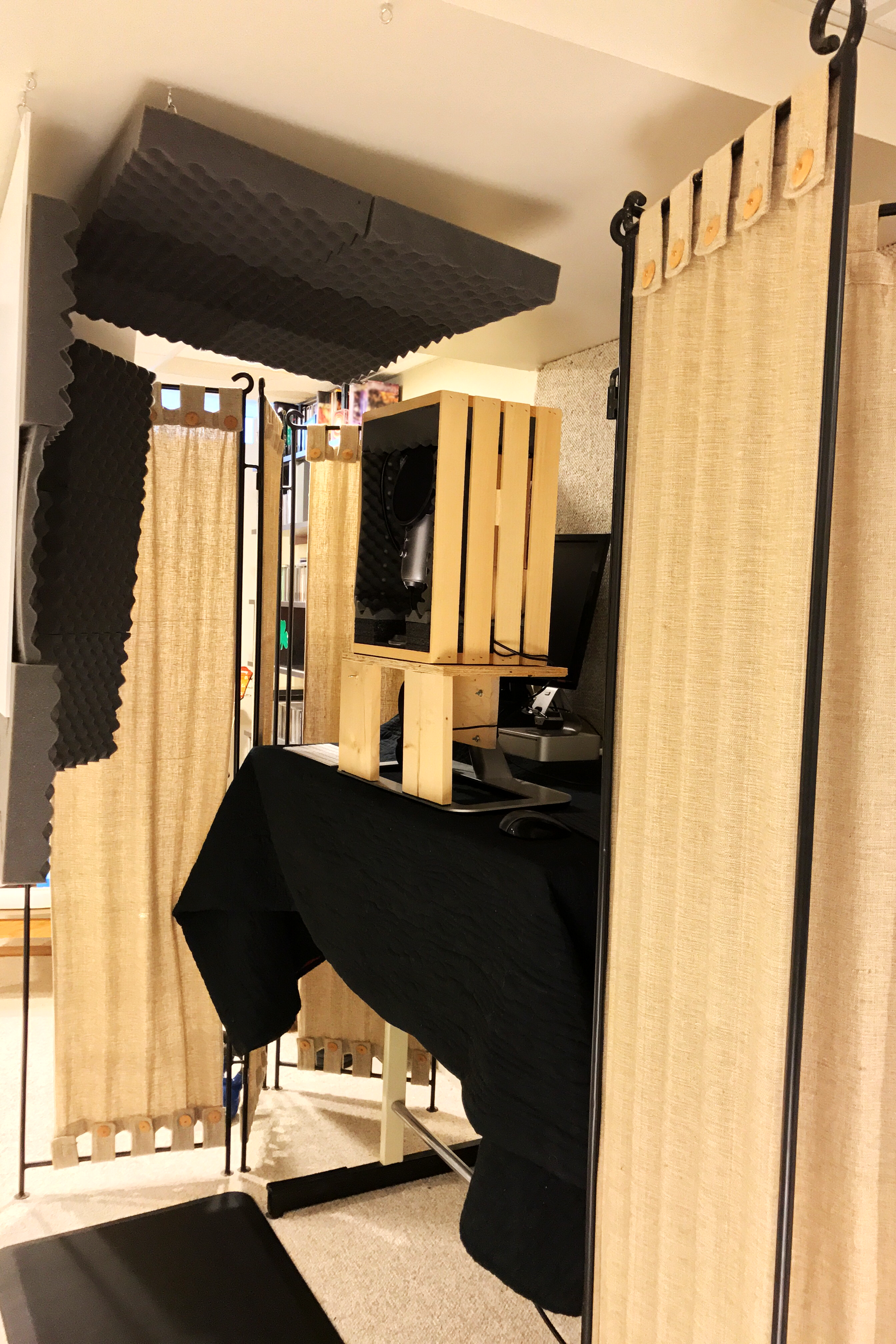
Even though the area was isolated from most of the noise in the house, there was still some ambient noises coming from the air conditioning ductwork above my head and the two vents into the basement on either side of me. So I got to work [over-]engineering a solution. During my research, I found a portable mic surround that would isolate the noise around the mic; rather than line the wall with foam, I thought this would be a good idea for the space. Later that day, my wife came home one day with a wooden crate at Michael's, presumably for my youngest's toys. But the moment I saw it, I thought of creating a box to stick the Yeti into, surrounding the mic with foam in order to isolate the mic from the ambient sound.3 After a few iterations and some on-hand materials, I had something I was happy with.
Although the desk is a nice height for standing, the microphone wasn't in the proper height for me to record, and I needed to elevate it. I looked around the house for unused items, rather than buying a stand or a boom arm. I ended up making a stand for it using the base for our TV that was going unused, as we had wall-mounted the TV. Using some spare plywood around the house, I was able to make up a shelf for the mic box to sit on. The mic can now be used sitting or standing, which gives me the option depending on how I'm feeling.4 I've also added a couple of brackets to set my headphones and cable ties to clean up the cords a bit.
Here's a "pro-tip" for setting up your own space: before you go buying anything, use what you have around you. You'd be surprised what a little thought and time will get you. I was able to get a lot of things just by rummaging around my house. The foam, the TV stand, repurposing the desk. Even the shelves I have for my desktop speakers were things just sitting: in fact, they are actually the corner packaging from a MacBook Air box. Reduce, reuse, recycle.
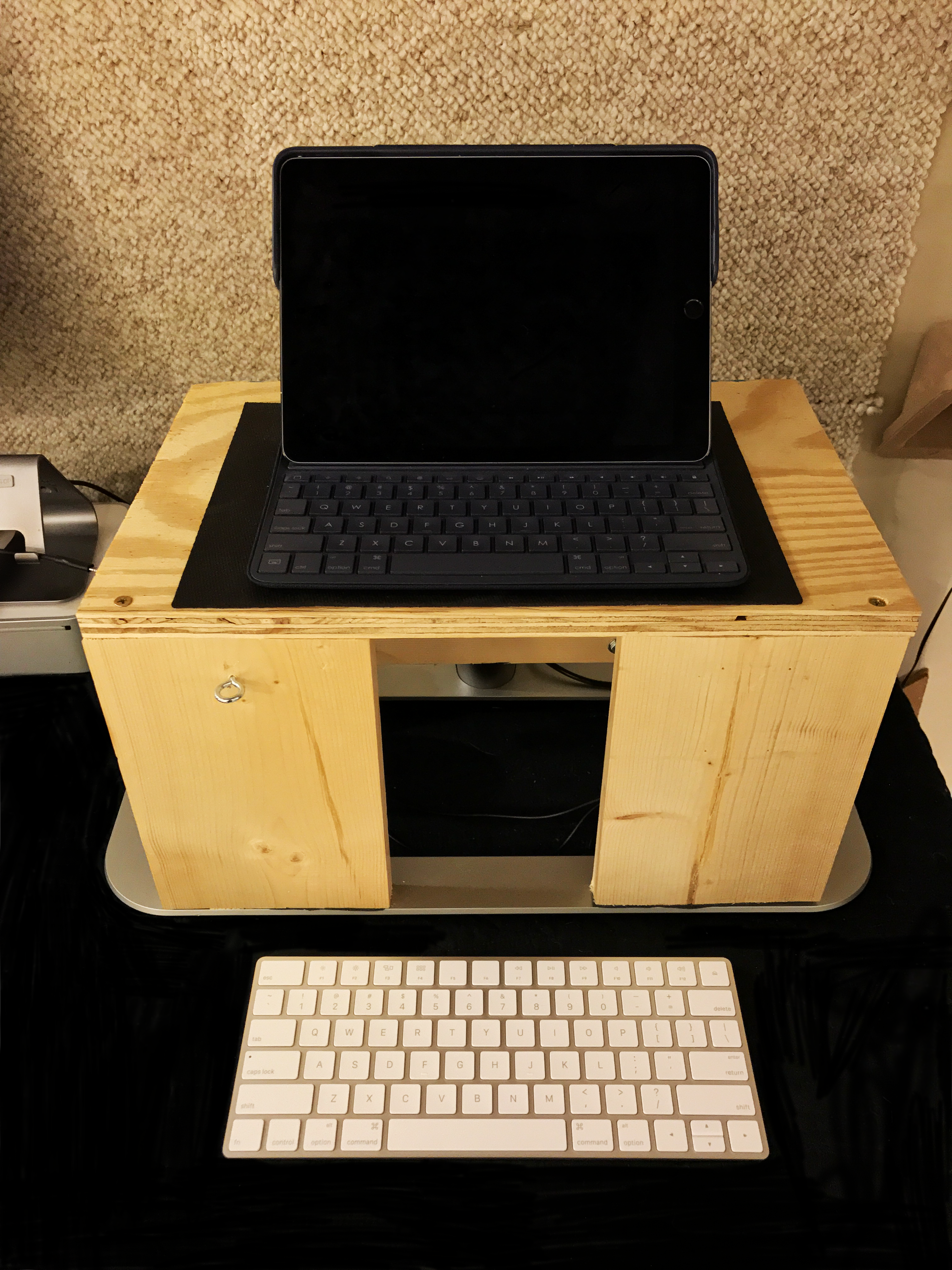
I've also been able to think about this space with more than just my podcast setup in mind. When I'm not recording and I want to do some serious writing, I can use the stand to elevate my iPad Pro in the Logitech Create Keyboard Case. For ergonomic purposes, I ended up picking up a Magic Keyboard to use not only with the Mac mini, but my iPad as well for longer writing sessions. Not only do I have a podcast space, but I also have a quieter space to write, be creative, and is a retreat that I didn't have previously. Having personal space is important.
I've used various foams I had around my house in the setup to isolate different things: the mic to the box, the box to the stand, etc. There was also ambient fan noise from the furnace. To minimize a lot of it (most of which was coming from the closet behind me), I had found some scrap foam and carpet remnant. I attached the carpet to the wall using a staple gun, and glued the foam to cardboard to hang behind me. Glueing the foam to cardboard didn't turn out well, and I ended up getting some foam-core poster boards. I attached the foam using special foam adhesives and are easy to apply (peel-and-stick). I affixed two adhesive hooks to hang each board by two small screw eyes from the ceiling. I also created a board for the ceiling, using the same strategy and a small piece of chain that I had lying around. We had some standing dividers, which were useful to set to the side to help minimize noise on the sides. With all of this set up, I basically ended up making a small studio.
I'm really happy with how all of this turned out. It's efficient and I've minimized how much money I wanted to put into this thing. I really truly have only put in under $100 total (not including the equipment), and the rest I was given or able to find/repurpose. In the future, I might pick up some better sound isolation foam from a local store, replace what I have, and add more; but for now, I'm going to keep utilizing this and be happy in my personal space. Being resourceful, reasonably mechanically inclined, and thinking outside the box about using some old items in my house, I have been able to make a decent setup that sounds good enough for audio quality. Sometimes, all you need to do is look around you and you'll find everything you need.
There's a great reference for using the adaptor over at Six Colors. It includes helpful tips and the capabilities/limitations of using it on iOS. ↩
At least until an iPad Pro with updated software can record both ends. Once that happens, then I'm likely going to be back to only iOS for everything. ↩
I was able to scrounge around and find some foam from various sources: old packing boxes, an old SuperDrive shipping box, some free toolboxes I got while in college. You can get it multiple places, but if you can get it for free, do it. It can only help improve the isolation. ↩
I'll generally be standing for recording, however, as I tend to fidget a lot. ↩
Every year in spring, it seems as thought I get sick at least once: the changing of the weather, additional allergens in the air, kids bringing home more and more germs. Whatever it is, it sucks more now that I'm an adult. It usually knocks me down in one form or another, and harder than it used to previously; I need more rest in ever increasing amounts. Getting old sucks.
So, as is tradition, I spent all of this past weekend sick. Naturally, the weekend hit a multitude of complications with our plans and family productivity. Obviously we, as a family, need to be flexible when something like this happens. But when I get sick, it puts a tremendous strain on everyone else in the family. Not as much gets done, our plans change, and everyone is usually bummed about it.
This time, the sickness also took something that made everything that much worse: my voice. It's simply laryngitis, and thankfully nothing worse. Not having one's voice is difficult, and I couldn't imagine life like this permanently; it's incredibly frustrating to have to figure out ways of communicating other than by speaking. I count myself unbelievably lucky that I have my senses. In a way, I'm grateful that this happened, because it has allowed me to think of things differently in terms of the accessibility of my devices, and also brought an unexpected accessibility feature along with it. There are times that we, as a family, need to communicate via messages — mainly due to the youngest one sleeping. I'll have to send messages to my teenager, who purchased his own Bluetooth on-ear headphones, and sometimes can't hear me talk, even when I'm right behind him.1 But this weekend was especially important. I don't like being a family that just texts from couch-to-couch, but we ended up planning dinner and our evening activities together in a group chat. Sometimes simple text can adequately convey your message.
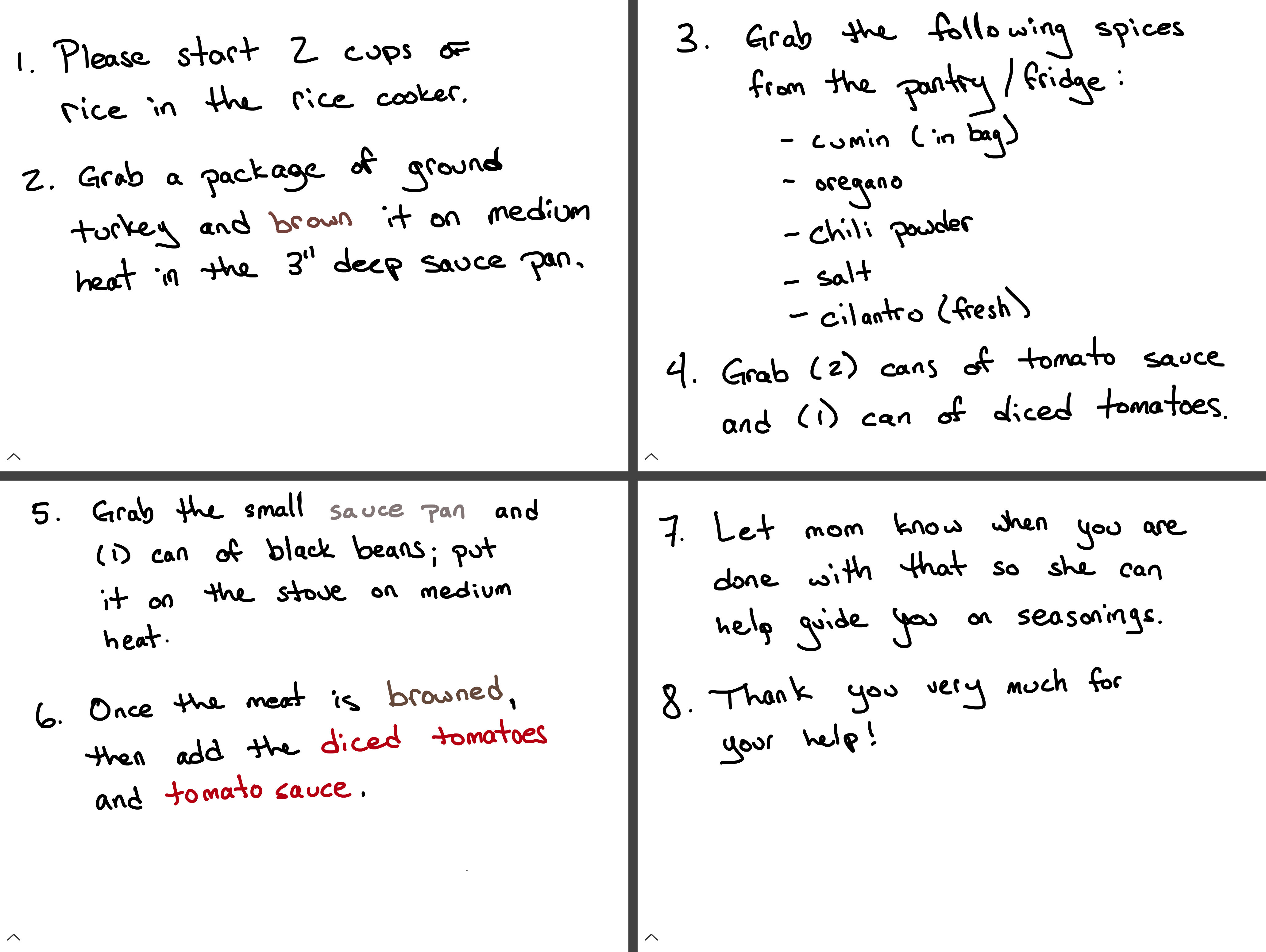
When it came time to make dinner, however, I wanted my oldest to make it. I try as often as I can to impart wisdom and small tasks that he should be able to do. But how on earth, with no voice, can I give him directions? My first thought was to send a text, but even though I can type fast, it wouldn't be good for what I need. So I looked on my iPad to see what tools I have at my disposal. It was pretty apparent that I should use Linea. I could simply use a white canvas and a black pen or marker to write. It was easy for me to write down some simple instructions for him. Using layers, I ended up writing out how to put things together, just as a reminder of the things he should be putting into the meal because he has made this before. It made it easier to communicate with him, and dinner turned out pretty well. Being able to simply write down directions to him was a huge help.
As the weekend went on, I continued to use Linea for communication in my house. We ended up doing more than I thought we would, despite my inability to communicate verbally. I interacted with my youngest by working on letters and numbers with him; I also drew him small pictures to make him laugh. While Linea is primarily an app for artists,2 Linea allowed me to get past a communication barrier I was facing, and interact with those around me.
When life throws you a curve ball or two, sometimes you find something unexpected that can help you along your way. I'm very thankful that I picked up Linea as soon as I got my iPad Pro. It was a wonderful weekend companion for me and allowed my voice to be heard with my family.
Recently I started playing around with different systems, making different changes to how I work. This should surprise exactly no one. Long story short, I'm reading Getting Things Done for the first time:1 not just passively reading and finding little hacks, but rather studying the material. I'm reading it very slowly; I'm using iBooks, highlighting passages and taking notes in various places on how it applies to me. So many people swear by the system, and I want to see what this system could do for me. With all that I have going on, I wanted to make sure that I have a handle on anything and everything that needs to get done. One of the things that has resonated with me so far is that the system isn't about just one task app. The notion that you can only utilize one of those apps often gets lost on people; the idea that a single task manager will solve all of your needs 100% of the time is a falsehood, even if someone tells you that "This task app is the best ever!" — even if that someone is me . Your needs change, your roles change, your life changes. Things need to evolve as you do.
From the book:
Your life is more complex than any single system can describe or coordinate…
Single system. You might need multiple as your life changes. You will, at the very least, need multiple parts for the system: a task manager, a calendar, email, and even some long-term reference storage. This could be all in a single app, but more than likely, it will be multiple apps. Sure, in the grand scheme of it, having multiple sources is really hard when it comes to conducting a weekly review and making sure you capture all of your tasks; it puts the onus on the user to review multiple places, which some can find difficult. Due to constraints at my workplace, I need to use two task managers to get my life sorted out as part of my system. This works for me if I am diligent about my weekly reviews; the weekly review is vital to making sure you don't miss anything, and you need to be relentless about conducting them. The weekly review is one of the key elements to a successful system, and I've been able to set up weekly reviews utilizing reminders for both work and personal, and I'm getting through life mostly unscathed.
One of the keys to the GTD methodology is capture. It works best when you have a single, trusted place for capture, so that you can process everything later: this is your Inbox. So while I could use any app to input tasks — like 2Do or OmniFocus or Reminders or Todoist or [insert app name here] — the important part for me is to set up my system so that the inbox for capture is the same. So that it's muscle memory. As it turns out, I have the muscle memory for this already: Drafts. As it is a permanent member of my dock, and that's where 99% of everything text related starts already, it makes total sense for me to use this as the GTD Inbox with my system. I utilize the app for so much, and I was doing most of this already. But one thing I wasn't doing was really utilizing it in the best possible way.
Before, I would write tasks down in a draft. Sending to a singular app is easy. Then, when I bifurcated my system and utilized one app for work and one app for home, I created separate lists to send over with actions for each list. But the separation was really hard for me to keep when I started trying to think of everything that I needed to get done in my personal and professional lives. In episode 3 of the GTD podcast, David Allen — the man behind the method — guides you through a mind sweep. I recommend sitting down and listening to the episode, and highly suggest you follow along. When I went through it the first time, I listened through it and often paused the episode when he mentioned certain things that triggered some tasks or actions that I needed to remember. I've done it a few times now, and each time I've thought of at least five additional items - some even larger projects - that I needed to ensure are in my system.
You might think that you need to use a singular task management app for this to work effectively. But through the power of Drafts' ability to tie into multiple apps, you can make it so that you can effectively do the mind sweep, and send things to where they need to go if you use more than one. For multiple reasons, I will need to keep a separate system for work so that I can process tasks on my work machine. But chaining things together in the right way will allow me to keep both task managers in my system, and really focus on capturing.
If I were to use a single system, the Drafts Action Directory is filled with great actions that can send various bits of the text — [[draft]], [[selection]], etc. — and create tasks simply. I most often use [[selection]] in my actions; if nothing is selected, it defaults to [[draft]] and grabs the entire contents. If I'm in a meeting taking notes, I can quickly grab each task out of that meeting and send them to Todoist, my work system. If I have an upcoming business trip that I need to make sure I have something packed for, I can send that over to my ever evolving personal system. I can add a calendar event or send an email. If I need to store some text for reference, I can even send it over to DEVONthink. You get the idea.
Even when I use a split task system, I can utilize multiple actions and send items to the apps I need them to go. However, to help better facilitate sending the mind sweep of my tasks all at once to other places, I created a simple workflow that takes the draft text as the input, then allows you to parse the tasks line-by-line into the system of choice.2 I don't need to think only of home, work, or family oriented tasks in separate ways when sweeping; I can think of everything in my life all at once, and send it where that needs to be. Not only can I send to multiple places, the workflow allows me to tinker with multiple apps to broaden my knowledge and experience.
What I'm finding out the more I get through the book is that even though I am using multiple-app system, I'm using as many apps as I need and as few as I can get by with. This reduces my mental overhead, and allows me to focus on the task(s) at hand; it's always there, always available, no matter where I am. Most importantly, I trust in it to work for me, so that all of the people around me at home and work can rely on me. As I continue to read and learn more, I'm hoping that this sparks some more ideas to apply the methodologies I'm learning. No matter what systems I try, no matter what new methods I am experimenting with, at the center of all of it is the foundation for my productivity: Drafts.
If you've read the book, or are a guru of this stuff, bear with me on all of this. You're probably going to think I'm really late to the party, and you're right — but I'm glad I'm expanding my knowledge. ↩
The workflow contains four such apps that I have used, but you could use whatever works for you. I made this simple example, but it can be done a number of different ways and you can make it customizable for your needs. You can add calendar, email, or reference storage to this as well. ↩
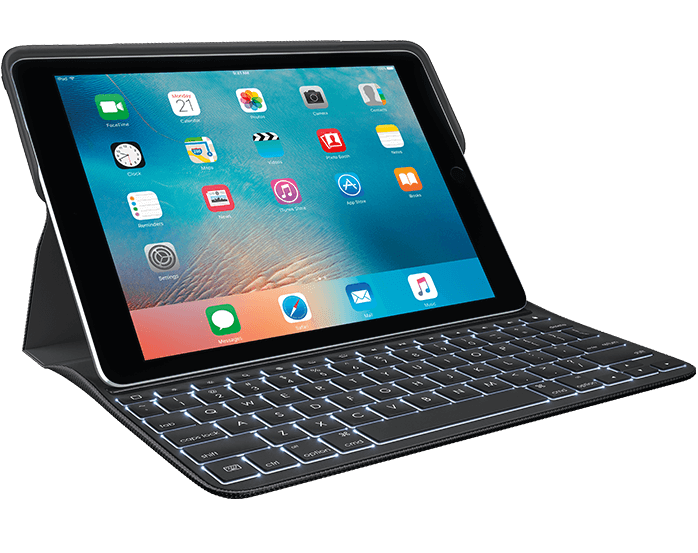
The moment I made the decision to get the iPad Pro 9.7", I knew that I wanted to get the Logitech Create Keyboard. This is hands down the best keyboard for the iPad Pro, as many other people will tell you.
What I love about this keyboard is that while it adds some heft to the device, it is still ultra-portable, and contains my entire work station in an all-in-one setup. In most cases, this is the only thing that I need to bring around with me. I can do some of my work, write to my heart's content, and get anything and everything done with efficiency. The keys are backlit, which is a nice touch over the keyboard that I previously had. It's the perfect compliment to the Apple Pencil, with the built in pencil loop. And the best part of all: it's attached to my iPad Pro. FINALLY.
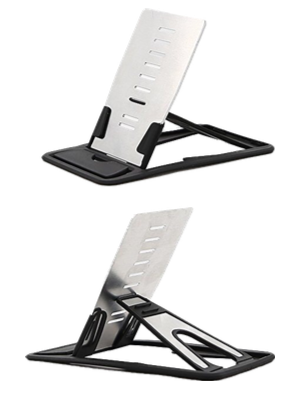
iMangoo Foldable Stand
Now that I have my iPad Pro with the Create keyboard, my old Logitech k480 has been given to my son for his use with his iPhone at school.1 Because I want his iPhone to last and it is permanently in a LifeProof Case, his phone doesn't fit so well into the integrated stand on the keyboard. So I started looking at options for him to use for a stand.
I originally was going to go after the current stand I have, but it isn't portable enough for what he would like. That's when I ended up finding the iMangoo Foldable Stand. It is a very portable stand; in fact, it's a little thicker than a credit card when fully collapsed. But it's capable of holding your phone or tablet just fine. It's not going to be the stand that looks pretty and is a perfect compliment to the Feng shui of your desk. It will, however, serve as a nice piece of kit in a carry bag that is a no-brainer. In fact, I ordered one for myself, and it's been working out very nicely. The perfect complement to the mobile workstation.
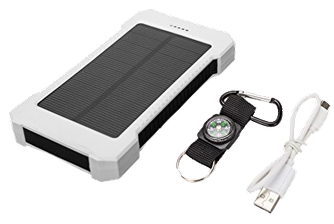
SOMAN Solar Charger
This charger came my way at Christmas time as a gift.2 During that time, I was also reorganizing some things inside my house, and put it somewhere out of the way. Out of sight, out of mind — and I forgot that I had it. Then I finally remembered it on a recent trip I had.
The SOMAN® Portable Solar Panel Charger is a 10000mAh battery dual-USB battery pack with a solar charger option. It is also rain-resistant, dust-proof, and shockproof. It charges via a microUSB cable that comes included. I used it at various times during the trip, and never had to recharge it the entire time.
The solar panels are meant to keep it topped up with charge, but can also fully charge the device if you are somewhere that wall charging isn't. And it even comes with an LED flashlight if you need one in a pinch. This battery pack is rugged, capable, and — best of all — fairly inexpensive at less than $15.
We've offered up to have him use a tablet, but he doesn't want to carry it. He only wants to carry his phone. A chip off the old block... ↩
In this modern world, I love the idea of mobile computing. And for the longest time, I was doing just that with my iPad nano (a.k.a. the iPhone Plus). Then I added an external keyboard, and things started to improve for my productivity. I started envisioning a future of an iPhone Pro, where iPad features were added to a smaller form factor. For a long time, I thought that would be all I needed. After a long while of some self-searching, and some poking and prodding by my co-host, I really started down the path of wanting an iPad Pro. The allure of it captured my imagination of what could be possible from a larger workstation. How much better could my daily workflows be? What are the limits I'm facing now, and how could those limits be shattered on this new device? Now I don't have to be eager to find out.
I am finding out. Finally.
I now have my iPad Pro (9.7"), along with a Logitech Create Keyboard and an Apple Pencil. My workstation is now perfectly mobile. I can take it anywhere, along with my iPhone 7 Plus, Apple Watch, and Beatsx earphones. A complete ecosystem of devices to allow me to be anywhere and everywhere, all while fitting everything into my backpack, including the cables and chargers. It is a powerhouse of portability and capability that just keeps getting better.
It took a while to get to this point. There was a lot of justification of the need and showing restraint, as opposed to giving in and satisfying my child-like want. It became more of a need as time has gone along,1 and now that I have it, I don't want to go back to life without it. I'm like a child that has discovered the power of Lego for the first time, but now it's all just ones and zeros. Digital (keyboard) and analog (pencil) inputs. Workflows and actions. Apps and systems. Simplicity and power.
Let's see where this new portable power takes me…
We've been without a proper computer for over a year now. The last one died in a fire pool of water. ↩